Friday, August 19, 2011

Monday, August 15, 2011
American Growth and Progress: 1820-1860
What follows is Dudeboy's first term paper. He has written many other shorter papers, but this is his first expanded work on a subject area of study. While Dr. J and I prodded him with questions and helped him expound in revisions, these are his words and ideas (however, Dr. J did type out most of it for him from his hand written pages). While some might argue some of his points, I think he should be very proud of his effort.
American Growth and Progress: 1820-1860
by Dudeboy
The changes that took place between the years 1820 and 1860 in the United States included acquiring and settling new lands, transportation, technology and social reforms. During this period the United States acquired new land through wars and treaties. As the United States territory grew, the population also expanded through immigration from Europe and Asia which contributed to western expansion into these recently acquired lands. New technologies helped shrink the time needed to communicate and travel between east and west. The time of this expansion was also the time of numerous social reforms. All these changes contributed to making the United States a world power.
In the early nineteenth century, the United States of America acquired land through the Texas Annexation, the Mexican-American War, the Gadsden Purchase, and the Oregon Treaty. The annexation of Texas was in 1846 which was ten years after the Texas war for independence. Between the years 1836 and 1846 Texas was a separate country from the United States and was called the Republic of Texas. After the Annexation of Texas there was still a border dispute between the United States and Mexico which brought about the Mexican-American War. Some people at the time thought the war was a tactic for expansion. One of these people was Frederick Douglass who said: “In our judgment, those who have all along been loudly in favor of the war, and heralding its bloody triumphs with apparent rapture, have succeeded in robbing Mexico of her territory. We are not the people to rejoice; we ought rather to blush and hang our heads for shame.” 1 The Gadsden Purchase expanded the United States after the Mexican War by buying from Mexico what is now part of Arizona and New Mexico. The Oregon Treaty was a deal between the United States of America and England that decided the northern border of the United States of America. This treaty gave land to the United States because the new border was on the 49th parallel which was higher than the original border. Acquiring all of this land greatly increased the size of the country allowing immigrants and settlers to fill it.
Difficult times led immigrants and settlers from Europe and Asia to the American west to mine for gold and work on the railroad. A potato famine in Ireland caused starvation. New factories in Germany and wars in China produced unemployment. These factors led people to seek a better life elsewhere. Tales of gold like this one published in a Norwegian newspaper drew people to the United States: “The gold we find is almost completely pure. The size of the nugget varies. In some places pieces have been found that weighed up to seven pounds.”2 Not everyone mined for gold. Some people did other jobs like working on the railroad.
Advances in communication and transportation including the Pony Express, telegraphs, clipper ships, and trains helped convey messages and people more quickly and more cheaply. The Pony Express was a fast way to transport news from east to west. But 18 months after the Pony Express started the telegraph put it out of business. The telegraph was an even faster way of communication; started in 1844, it sent news instantaneously. Clipper ships could take people and letters from Boston to San Francisco in about 89 days. The transcontinental railroad was even faster at moving news and people than the clipper ships. It took about two weeks to travel cross country by train. The painting American Progress (1872)3 depicts the importance of trains, telegraphs, stage coaches, wagon trains, and the Pony Express in the expansion of the United States of America.
During this time of expansion and technological advances there were also many great social changes including abolition, temperance, women's rights, and educational reforms. Many of these movements were intertwined. The abolitionist movement sought to end slavery through newspapers like William Lloyd Garrison's The Liberator and speeches by Fredrick Douglass and others. The temperance movement tried to end the drinking of alcohol. One key figure was Lyman Beecher (the father of Harriet Beecher Stowe) who founded the American Society for the Promotion of Temperance in 1826. Women like Elizabeth Cady Stanton, Lucretia Mott, and Susan Brownell Anthony worked towards the rights of women, like the vote. The Seneca Falls Declaration (1848) said: “We hold these truths to be self-evident: that all men and women are created equal.”4 Educators like Horace Mann improved education by starting schools to train teachers, raising teachers' wages, improving the curriculum, and extending the school year.
The acquisition of this land greatly increased the size of the United States. The diversity of this country was also greatly increased due to immigration. Technological advances made travel and communication faster, easier, and cheaper. Educational improvements made it possible for more people to go to school. However, controversial issues like abolition, temperance, and women's rights were left unanswered at the end of this period. One of these conflicts led to the largest war in American history: the Civil War.
1Joy Hakim, A History of US, vol. 5, Liberty for All?, rev. 3rd ed. (New York: Oxford University Press, 2005), 64.
2Hakim, 74.
3Hakim, 49.
4Hakim, 131.
Saturday, August 13, 2011


Monday, August 8, 2011
Kingdom of Fife Film School . . . July
Here is the twelfth installment of the Kingdom of Fife Film School. These are the films Dudeboy watched during July with his ratings.
Evil Under the Sun 8 stars [1982; UK; watched 7.31.11]
Sherlock Holmes and The House of Fear 8 stars [1945; US; watched 7.31.11]
Searching for Bobby Fischer 8 stars [1993; US; watched 7.30.11]
Hounds of Baskervilles 8 stars [1939; US; watched 7.29.11]
King Kong 9 stars [1933; US; watched 7.16.11]
Sherlock Holmes the Sign of Four 8 stars [1987; UK; watched 7.13.11]
Rear Window 9 stars [1954; US; watched 7.6.11]
Labyrinth 8 stars [1986; US/UK; watched 7.4.11]
Gladiator 8 stars [2000; US/UK; watched 7.2.11]
Wednesday, August 3, 2011
Morgan's Great Raid . . . part 4, Side Excursions

John Hunt Morgan in the Ohio State Penitentiary . . . actually, Dudeboy at Jailhouse Pizza in Brandenburg, Ky. It is located in the former jail for Meade County. Many years ago, Adonis Gorr and I wandered through the structure when it sat abandoned. It is nice to see that it has been saved. And the pizza was pretty darn good.


One of the many formations in this very scenic cave.


Here lies what is left of Squire Boone . . . he was the brother to Dudeboy's great-great-great-great-great-great grandmother Hannah Boone.


Aboard the horse-drawn canal boat at Metamora. At one time, the canal was around 100 miles long. However, today the trip only lasts about 30 minutes or so.


This thing is rigged to shoot flames out of one appendage!


From the historical marker at the real town of Dupont . . . "Confederate forces under Gen. John Hunt Morgan camped near Dupont the night of July 11. They destroyed railroad track, burned bridges, freight cars and a warehouse, and stole 2,000 hams from Mayfield's pork house."


Dudeboy at one of the interactive exhibits.


It took awhile, but the Federals finally caught up with us . . . unlike Morgan, we were paroled and quickly returned home.
Monday, August 1, 2011
Morgan's Great Raid . . . part 3, Ohio
And rich Ohio sat startled, through all those summer days,
For strange wild men were galloping over her broad highways
Now here, now there, now seen, now gone, now north, now east, now west.
Through river valleys and corn lands, sweeping away her best.
A bold ride, and a long ride! But they were taken at last;
They almost reached the river, by riding hard and fast.
But the boys in blue were upon them, ere ever gained the ford.
And Morgan, Morgan the Raider, laid down his terrible sword!
Excerpt from the poem Kentucky Belle by Constance Fenimore Woolson
In 1860, Ohio was the third most populous state in the US (after N.Y. and Pa.) with 2,339,511 people. Cincinnati was the seventh largest city in the country with 161,044 residents (Louisville was ranked 12th with a population of 68,033). When Morgan and men crossed that street in Harrison separating Indiana and Ohio, the numbers of the opposition the raiders would encounter would be far greater than anything previously experienced. And, they were still being pursued by Hobson, Wolford, etc.

At the time of the raid, Camp Dennison was the largest military hospital in Ohio. Noted on an information plaque at the site is this admission, "In July of 1863, Morgan's Raiders passed embarrassingly close to the garrison at Camp Dennison and without any challenge burnt a locomotive and 3 coaches of the Little Miami Railroad."


While in Wilkesville, Morgan stayed in this house belonging to Dr. William Cline (one of the richest men in Vinton County). Morgan hoped this was to be his last night in Ohio.


As the pressure was closing in on Morgan and his men, they had to pass through this area dubbed "the gauntlet" as they desperately tried to get to the Ohio River crossing at Buffington Island.


Just out of Bashan is a small cemetery where the raiders once again interfered with a funeral procession . . . except this time they took the horses and the hearse, which they filled up with the wounded. Bashan is also near the birthplace of the great Ambrose Bierce.


Early on the morning of July 19th, fresh Union troops under the command of Henry Judah somewhat unexpectedly found themselves attacking a part of Duke's command. Shortly thereafter Hobson and his men attacked parts of Johnson's command from the north. All the while, the Union gunboat the USS Moose arrived (later joined by the Allegheny Belle) and began harassing the few Morgan men who had begun to ford the river. Less than 50 raiders made it across before the ford was blocked by the gunboats. Morgan's only option was to escape and try to ford elsewhere. The remainder of his command of about 1,100 men (Morgan's casualties at the battle were 57 killed, 150-200 wounded, and about 750 captured) attempted another crossing about 6 miles upstream at Reedsville. About 330 raiders made it across to West Virginia (which was only admitted to the Union the month before) before the Moose forced Morgan inland once again. John Hunt Morgan himself was actually half way across the river, but he returned so as not to abandon the majority of his command who would be stranded on the Ohio side.




Saturday, July 30, 2011
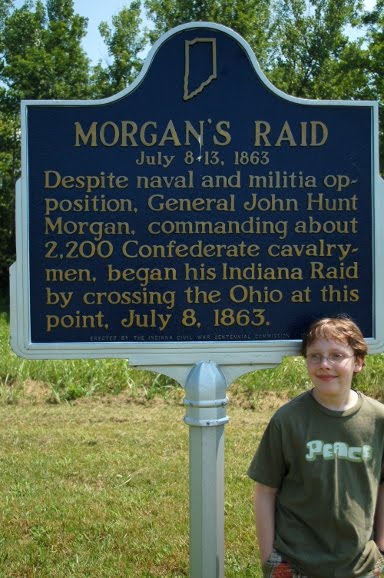
Morgan's Great Raid . . . part 2, Indiana
I'm sent to warn the neighbors, he's only
a mile behind;
He's sweeping up the horses, every horse
that he can find.
Morgan, Morgan, the raider, and Morgan's
terrible men,
With Bowie knives and pistols are galloping
up the glen.
Excerpt from the poem Kentucky Belle by Constance Fenimore Woolson


As Morgan and his men advanced towards Corydon, one of the raiders was shot and killed. Suspecting that the shot came from the Glenn home, the raiders retaliated by killing Peter Glenn and wounding his son.

Dear Cousin
. . . We have had rather exciting times in Indiana, for the last few weeks, and have had a few of the miseries of the south pictured to us though in a small degree. On the doubly memorable ninth of July a visit was paid to the citizens of Corydon and vicinity by Morgan and his herd of horse thieves. We heard Tuesday night that they had crossed the river and had disgraced the soil of Indiana with their most unhallowed feet. Our home guards skirmished with the rebs from the river to [Corydon] and on one of the hills overlooking the town had a grand battle. The battle raged violently for thirty minutes, just think of it! And on account of the large number of the rebs we were forced to retire which our men did in good earnest every one seemed determined to get out of town first but which succeeded remains undecided to this day. After the general skedaddle, Col Jordan wisely put up the white flag- and we were prisoners to a horde of thieves and murderers. I don't want you to think I am making fun of our brave home guards for I am not in the least. But now, that all the danger is over, it is real funny to think how our men did run. . . . It made Morgan so mad to think a few home guards dared to fight his men. I am glad they done it just to spite him. However they captured most of the guards and parolled them and killed three of our men. . . . One of our brave boys run three miles from the rebels, and really run himself to death. He stopped at a house and fainted and never came to. Didn't he deserve a promotion? I think that was the awfullest day I ever passed in my life. . . . The rebs were pretty hard on the copperheads but they did not take a thing from us. . . . I expect you are tired of hearing about Morgan so I will stop. I forgot my letter till so late this morning, and I have not got time to write much more or I will be too late for the stage so Goodbye.
Attia

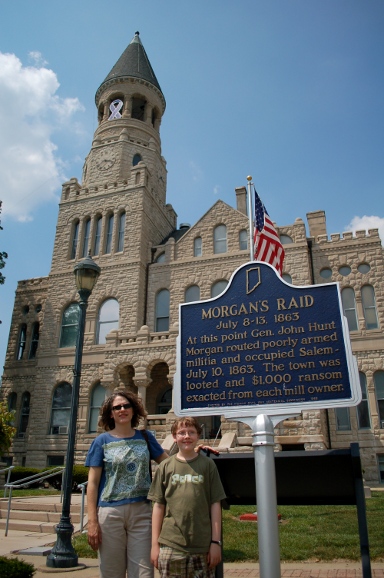

After Salem, the raiders stopped in Canton and cleaned out this store (now called Fox's Country Store). There are benches in the store made from planks of the "Old Plank Road." Throughout the raid, George "Lightning" Ellsworth provided Morgan with critical information on the Union movements by tapping into the telegraph. Ellsworth stayed busy at several stops in this area . . . sending bogus, misleading messages and gleaning information about the whereabouts of their pursuers.


Our favorite Morgan monument (located southeast of Dupont) on the trip . . . "Gen. John Morgan's troops going east ate breakfast here Saturday, July 12, 1863."


Across the street from St. Paul's are two more buildings from the time of Morgan's raid. Morgan slept in the building on the left, which at the time of the raid was the Jacob Gephart Saloon. And the building on the right was Tony Blettner's Tavern. Morgan located his headquarters here. You can reenact the raid at this point by going in and drinking a beer, as it is still a tavern.


West Harrison, Indiana . . . just across State Street (left in the picture) is Harrison, Ohio. As the raiders moved on to Ohio, the men helped themselves to Indiana hospitality one last time. According to Lester Horwitz, one man was "observed to have a bird cage with three canaries, which he carried for three days."