Wednesday, July 21, 2010

DC Trip - Oddments, part 3 . . . Human Hairball and the NMHM


A trichobezoar from a 12-year-old girl on display. Thankfully, she survived the surgery to remove it. Go to the NMHM website for hairballs to learn everything you need to know about bezoars.


Dudeboy's obsession with the assassination of Lincoln is what brought us to the NMHM. In a past entry we described some the other Lincoln artifacts housed here, but among the more disturbing are fragments from Lincoln's skull.


Union General Dan Sickles was somewhat of a controversial figure in both public and military life. However, he must have had somewhat of a sense of humor, as he would bring friends to visit his mangled limb (Gettysburg) on the anniversary of the amputation.


Two casualties from the Battle of the Wilderness.


Elephantiasis of the scrotum and leg.

Monday, July 12, 2010

Indiana Natural/History

Vic, Dudeboy and I met up near Taswell, Indiana to look for an arch lead that proved elusive. However, we did get to visit the large Yellow Birch Arch that is also in the area.

Yellow Birch Arch . . . for scale, Dudeboy is in the lower right corner. This arch is close to 40' wide.


After parting from Vic, we then proceeded on to Lincoln Boyhood National Memorial. Dr. J and Dudeboy had visited here several years ago when he was only four or so, but he didn't really remember it. So, since we were in the area, we decided to give it another go.


The Lincoln Boyhood National Memorial features five sculptured panels by E. H. Daniels. Each represents an important facet in the life of Lincoln. For a description of the Kentucky panel, the national park website states:
KENTUCKY PANEL: 1809-1816.

The Childhood Years of Lincoln.

The Kentucky panel illustrates the years of Lincoln's life spent on the Sinking Spring and Knob Creek farms. On the far left dressed in the style of the frontier is Jesse LaFollette, grandfather of Wisconsin Senator Robert M. LaFollette and neighbor of the Lincolns at Knob Creek. Beside him stands Thomas Lincoln, father of the President.

Seated is Dr. Christopher Columbus Graham, doctor, scientist, and visitor at the Lincoln home. His stories fascinated Abe, who is pictured here at the age of seven. Behind the boy is his mother, Nancy Hanks Lincoln. Sarah, his only sister, stands at the chum. On the far right is Caleb Hazel, Lincoln's second schoolteacher.


The grave-marker for Lincoln's mother Nancy Hanks Lincoln. The exact location of her burial is unknown, but she was buried somewhere on this hill just south of the family's farm.


The bronze casting of the Lincoln family cabin at a place where old timers marked the location.


I doubt that smile would be on his face if those hooks were really attached to buckets filled with water.

Friday, July 9, 2010

DC Trip - Oddments, part 2 . . . The Spotsylvania Stump


The website for the national park service states that "the longest sustained intense fight of the Civil War occurred at the Bloody Angle . . . For up to 20 hours men were engaged in a hand-to-hand and close-in fight that not even darkness put an end to." And testament to that is the Spotsylvania Stump. Even knowing what took place here I still find it incomprehensible that a 22-inch oak tree could be whittled down to a stump just by miniƩ balls! Robert E. Lee was incredulous as well . . . until he was shown the severed tree after the battle. Apparently, about a year later, relics hunters claimed the stump and hid it away until Union soldiers "liberated" it. The stump was brought to the Smithsonian in 1888, and can still be seen in the Price of Freedom: Americans at War exhibit in the National Museum of American History.


The remains of the stump still riddled with miniƩ balls at the Smithsonian.

Saturday, July 3, 2010

DC Trip - Oddments, part 1 . . . Cher Ami


One can not see everything at the Smithsonian museum complex. The scope is just too vast. So, you have to plan ahead to make sure important exhibits are not missed. For the Fife clan, this amazing pigeon was near the top of the list of things to see. Located in the Price of Freedom: Americans at War exhibit in the Smithsonian National Museum of American History, Cher Ami was awarded the French "Croix de Guerre" for heroic service. This is an award that was given to other notables such as Pa's hero Alvin York and fighter ace Eddie Rickenbacker! Cher Ami, which means "Dear Friend," carried vital messages for American forces in the Argonne Forest. However, his last mission is why Cher Ami is one of the most notable birds in history. Remnants of the "Lost Battalion" were not only cut off and surrounded by Germans, but were also enduring "friendly fire." A note stating "WE ARE ALONG THE ROAD PARALELL 276.4. OUR ARTILLERY IS DROPPING A BARRAGE DIRECTLY ON US. FOR HEAVENS SAKE STOP IT" was attached to Cher Ami's leg. He was their last hope as all other runners and pigeons dispatched did not make it. As Cher Ami rose to the sky the Germans opened a barrage to bring him down. And they were successful, for Cher Ami was shot and plunged toward the ground. But miraculously, the pigeon rose again to fly 25 miles in 25 minutes. When he arrived, the message dangled from a leg that was only connected by ligaments. He had been shot through the breast and he was missing an eye! Medics worked to save his life, but they could not save the leg. He was fitted with a wooden leg, but Cher Ami died from his wounds about nine months later. Out of some 550 men in the "Lost Battalion," only 194 walked out. The rest were captured, wounded or killed.


In the background is another animal hero from WWI . . . Sergeant Stubby.

Wednesday, June 30, 2010

DC Death March, part 8

Happy Fun Day 8

This was the last day of our summer D.C. trip (excluding the drive back). We went to Arlington National Cemetery first thing - before breakfast even. We saw the grave-sites for the two presidents buried there: William Howard Taft and John F. Kennedy. Taft was the last president to have facial hair. Perambulating through the cemetery, we ascended the heights to Arlington House (Dr. J did the honors for that sentence). This was the residence for Robert E. Lee before the Civil War. It is odd to realize how close he lived to the capitol of the country he betrayed. It is unfortunate that you cannot visit the graves of most of the notables buried here for you cannot leave the pavement.


The John F. Kennedy Eternal Flame.


Fairly nondescript marker for such a "great" man.


The traitor's house over looking our nation's capitol.

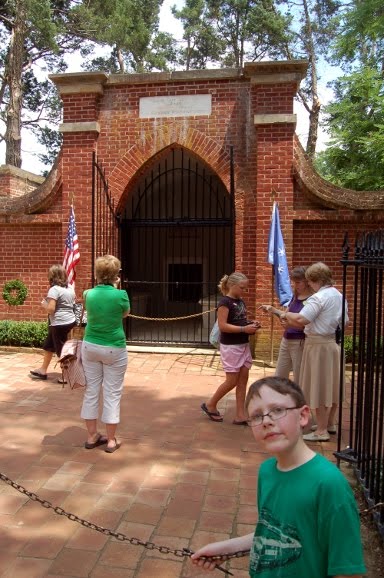
After leaving Arlington, we followed the Potomac to Mt. Vernon. While touring the house, we found out that Washington shared my favorite color: green. The outside of the house looks like it's made out of stone, but George Washington put sand in the paint to make the wood have a texture that mimicked stone. It had a beautiful view of the Potomac just past the ha-ha wall (look that up to find out what it was). Washington and Jefferson had the self-fanning rocking chair invented by Ben Franklin. We went to his tomb and the slave burial ground. In the educational center we saw a film about the Revolutionary War with fog, falling snow, and seats that shook when the cannons fired. We saw his dentures. He had several pairs but none of them were made of wood. We saw the bust that was the best likeness of Washington.


From Bowling Green to a bowling green.


Dudeboy visiting with the sociable Martha Washington.


There was a crypt built for Washington under the Capitol Dome. He chose this spot.

We drove back through DC to the National Museum of Health and Medicine located on the grounds of the Walter Reed Army Medical Center. It was a lot like the Mutter Museum: lots of preserved medical oddities. We went there to see Lincoln's skull fragments and the bullet that killed him. We also saw a giant human hairball and other weird things. Several exhibits explored different types of war injuries and an extensive collection of historic microscopes.

Big sigh. When we got home I had to take a vacation from our vacation and went to Mane and Pa's for a few days.


Multiple oak cabinets . . . a sure sign of a quality museum.


A true curio cabinet . . . filled with Lincoln assassination artifacts.


Lincoln's blood matted hair.


*This is the last detailed blog entry on the trip, but check back for photos of interesting odds and ends--with an emphasis on odds.

Sunday, June 27, 2010

DC Death March, part 7

Happy Fun Day 7

We went to the National Archives in the morning. There was no photography allowed inside the building. We saw America's most celebrated documents: the Declaration of Independence, the Constitution, and the Bill of Rights. It surprised us how faint the Declaration was. The Magna Carta has several copies in existence; we saw the only one in the United States. They also had a special Civil War exhibit called Discovering the Civil War. One of the weird things in it was a document that showed somebody had been drafted after he had already been killed in the war.

We walked through the National Gallery of Art Sculpture Garden. My favorite piece was Typewriter Eraser Scale X by Claes Oldenburg.

We spent the rest of the day at the National Air and Space Museum. My favorite part of it was the air part because it was closer to the ground. Some of my favorite things were Amelia Earhart's plane, the Spirit of St. Louis, a replica of Sputnik, lunar modules, WWI airplanes and pilot uniforms, WWII airplanes like the Mustang, Spitfire, Zero, Messerschmidt. I got to touch rocks from Mars and from the moon. But my very favorite exhibit was the Wright Brothers' Flyer and gliders. As usual, we didn't leave until the museum closed.


The National Archives.


Typewriter Eraser, Scale X by Claes Oldenburg and Coosje van Bruggen.


The Wrong Brother in front of the Wright Flyer.


A French SPAD XIII flown by American ace Arthur Raymond "Ray" Brooks.


A Mitsubishi Zero zeroing in.


Don't mess with the Messerschmitt Bf. 109.


Suits worn by John Glenn and Yuri Gagarin.


Alien discovered.