Monday, October 1, 2012

War of 1812 Road Trip . . . Along the Way, part 2

On the ferry at Put-in-Bay

On the way back from South Bass Island.


The people of Almería, Spain might have something to say about that claim.  However, Crystal Cave is very impressive, whatever the claims may be.


Marblehead Lighthouse is "the oldest, continuously operational lighthouse on the Great Lakes."

The Marblehead Lighthouse was built in 1822.

After the s'mores . . . a contented look upon Dudeboy's face.

The impressive statue of Custer in Monroe, Mi.

The Monroe County Historical Museum in Monroe, Mi. has quite a collection pertaining to Custer, including the original headstones for Custer and a few others that were originally located at Little Big Horn.

I can't remember the history of this big Lincoln head.  For a county museum, it had a really nice collection of Civil War artifacts.

The main body of the trip ended with a visit to The Henry Ford Greenfiled Village.  Whatever you think of Ford, it is pretty admirable that he had the forethought to save, collect and move this stuff here. Granted I would much rather have seen these old buildings preserved in their original location, but based on the decisions of the powers that be, many of these structures probably would not exist today.  Above, is part of Edison's Menlo Park.


The world's first Industrial Research Laboratory at Menlo Park.

The Wright Cycle Shop.

While at the Greenfield Village we were able to watch a bit of historic baseball.  What I have shown here is but a very small sampling of what we did and saw at the village.  Of course, an earlier entry related our visit to a War of 1812 encampment.

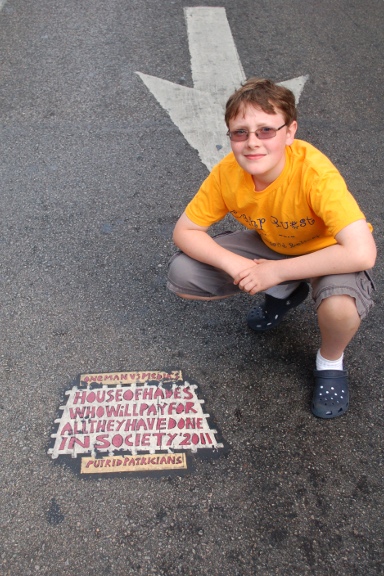
In search of a couple of Toynbee Tiles in Cincinnati*.  Unfortunately, they had been paved over.  However, we did not suffer a total loss as someone had placed a copy-cat tile with a different message.  The Toynbee Tiles always had this message . . . 
TOYNBEE IDEA IN MOViE `2001 RESURRECT DEAD ON PLANET JUPITER
And there was usually attached a smaller tile with additional cryptic blathering.  

The above copy-cat tile states:
ONE MAN VS MEDIA'S HOUSE OF HADES WHO WILL PAY FOR ALL THEY HAVE DONE IN SOCIETY '2011 PUTRID PATRICIANS
I highly recommend you seek out the 2011 documentary Resurrect Dead: The Mystery of the Toynbee Tiles.  

*The link I give for the Cincinnati tiles is outdated.  All are no más.
  
As mentioned in a previous entry, we stopped by the Kentucky State Fair on the way home and Merkin felt inclined to try the Krispy Kreme Hamburger.  To make it especially disgusting I got it fully loaded.  And, oddly enough, it was disgusting.            
Friday, September 28, 2012

War of 1812 Road Trip . . . Along the Way, part 1

The last couple of War of 1812 Road Trip entries will cover the other places we visited which did not pertain to the war.  Dr. J has great tolerance, but even she has her limits . . . throw in a couple covered bridges, etc., here and there, and she was a happy camper.  Whilst we were in Vincennes for Harrison's house, we made another visit to George Rogers Clark National Historic Park.

Inside the rotunda of the George Rogers Clark memorial.

While driving the backroads in Indiana, I spied a historical marker than made me come to a stop . . . the burial place of Jane Todd Crawford!  Above, to the chagrin of Dudeboy, Dr. J is portraying the pain Crawford must have experienced when Ephraim McDowell performed the world's first ovariotomy in Danville, Ky.  The removed tumor weighed a total of 22 1/2 pounds!  And this was done without the use of any anesthesia.  Dudeboy and I visited the McDowell house a few years ago.
The Home of Eugene V. Debs in Terre Haute, In.  Unfortunately, it was closed.  The marker states: 
Debs (1855-1926) was leading pioneer in industrial unionism, social reformer, and peace advocate. Founded American Railway Union, 1893; cofounded American Socialist Party, 1900; and ran five times for United States presidency. Home built in 1890; declared National Historic Landmark, 1966.


Mecca Covered Bridge, located near Mecca, Parke County, In . . . 1873.  

Parke County, In. proclaims itself to be the "Covered Bridge Capital of the World."  There are 31 covered bridges located in the county.


Sim Smith Covered Bridge, located near Montezuma, Parke County, In . . . 1883.

Phillips Covered Bridge, located near Montezuma, Parke County, In . . . 1909.

The Narrows Covered Bridge, located in Turkey Run State Park, Parke County, In. . . . 1882.

The suspension bridge that crosses Sugar Creek in Turkey Run State Park.

Rocky Hollow Canyon in Turkey Run State Park.


The Cox Ford Covered Bridge located on the western edge of Turkey Run State Park, Parke County, In. . . . 1913.

The Wilkins Mill Covered Bridge located near Rockville, Parke County, In. . . . 1906.

Historic Prophetstown (located in Prophetstown State Park and near the original site of Tecumseh's village) represents a working 1920's farm.  Our favorite attraction was the replica Sears Roebuck and Company catalog farmhouse. 

Miami Indian Cemetery near the Mississinewa Battlefield.  A nearby historical marker states that this is:
The largest Indian cemetery in Indiana. Few graves are marked. The Indians buried here are largely descendants of Chief Metocinya and include Meshingomesia and his family. The first burial was probably in 1873. Burial was contrary to Indian tradition and reflects Christian influence. An Indian Baptist Church and an Indian school were located here. Otto Winger taught at the school 1895-1898. This land is part of the last Indian reservation in Indiana. The site of the battle of Mississinewa (1812) may be seen along the Mississinewa River to the southwest.  
Statue of Edith Hamilton at the Headwaters Park in Fort Wayne, In.  


Turkey Foot Rock . . .
On this rock according to tradition, Chief Turkey Foot of the Ottawa Indians rallied his warriors during the Battle of Fallen Timbers. Here he was killed and for many years tribesmen made offerings of tobacco on the rock to appease the Great Spirit.
And on the monument in the back . . . "In memory of all the American Indians who gave their lives at this place, including members of the following tribes: Chippewa, Ottawa, Delaware, Potawatami, Miami, Shawnee, Mingo, Wyandot"


The Fallen Timbers Battlefield Monument . . .
To General Anthony Wayne who organized the “Legion of the United States” by order of President Washington and defeated Chief Little Turtle’s warriors here at Fallen Timbers August 20, 1794. This victory led to the Treaty of Greenville, August 3, 1795. Which opened much of the present state of Ohio to white settlers.
Elsewhere on the same monument it also states, "In memory of the white settlers massacred 1783-1794."  And on the back it states, "To Chief Little Turtle and his brave Indian warriors."

Lake Erie at Maumee Bay State Park . . . our home away from home for most of the trip.

Wednesday, September 19, 2012

War of 1812 Road Trip, Days 7 and 8 . . . "That was weird"

The Battle of Brownstown (Gibraltar, Michigan) . . . .
In this vicinity on Aug. 5, 1812, six weeks after the outbreak of war, an Indian force, led by the famous Shawnee chief, Tecumseh, ambushed about 200 Americans under Major Thomas Van Horne who were on the way south to the River Raisin. There, supplies vitally needed by Hull's army in Detroit, were awaiting an escort through the Indian blockade of the River Road. Tecumseh opened fire as the Americans forded Brownstown Creek. Van Horne, overestimating the Indians' numbers, ordered his men to fall back. The retreat soon became a panic-stricken flight back to Fort Lernoult. Seventeen Americans were killed, 12 wounded, and two captured and murdered. One Indian was killed.
The original monument for the Battle of Brownstown was dedicated in 1908 (it was rededicated in 2006).

There are a couple of odd inscriptions  . . . one of which Dudeboy is pointing to.  Look at the photo below for a close-up.

Obviously, not everyone thought highly of Tecumseh!  This reminds me . . . there is a high school in Oklahoma called Tecumseh High School.  And the name of their mascot?  You guessed it, the Savages!

This result of this seemingly insignificant battle coupled with the Battle of Monguagon (fought just a few days later) was that Hull now believed that his supply lines were compromised.  Which, of course, bolstered his decision to surrender Detroit.  I daresay, the worst decision in the entire war.
  
If anyone asks you what was the end result of the War of 1812 . . . well, now you have your answer.

The marker for the Battle of  Monguagon, or Maguaga (Trenton, Michigan) reads . . .
On August 9, 1812, a force of about 600 American troops, regulars and militia, moved down the River Road in an attempt to reach Frenchtown (Monroe) and bring back supplies needed desperately by the Americans in Detroit. At a point that cannot now be exactly located, near the Indian village of Monguagon, American scouts ran into a British and Indian force of about 400 hundred men, led by Capt. Adam Muir and Tecumseh, blocking the road south. Lieut. Col. James Miller quickly brought up his Americans and, in a running battle, drove the enemy back through present-day Trenton until the British pulled back across the river into Canada. Losses were heavy. Ironically, this the only battle won by the Americans in Michigan during the War of 1812, was followed a week later by Hull's surrender of Detroit.
We spent the rest of the day at Greenfield Village.  Of course, we timed our trip to coincide with the War of 1812 Muster at Greenfield Village in the Porches & Parlors Historic District of Greenfield Village.  

We got to see the War of 1812 reenactors drill and parade.  There were musket and cannon firings.  And Dudeboy got to participate in a kids' recruitment and drill.  He had a big time.
 
Dudeboy getting looked over by "ol' sawbones" to see if he is fit to volunteer.  

The "raw" recruits . . . 

The kids actually got to march on the parade ground with the reenactors.  I daresay, Dudeboy would be just as happy to be a War of 1812 reenactor as he is Civil War.

On the way home we stopped by the Kentucky State Fair where there was a special exhibit called War Hawks & Valiant Volunteers: Kentuckians in the War of 1812.  One of the items on display was this British drum taken by Kentuckians at the Battle of the Thames.

"Well, that was weird" exclaimed a teenage girl to her friends after the patriotic finale of the 30-minute musical BraveHunters of Kentucky! . . . Kentuckians in the War of 1812 put on by a local performing arts school at the Kentucky Sate Fair.  "That was weird" . . . a perfect way to summarize not only the musical, but the war itself.