Wednesday, June 16, 2010

DC Death March, part 5

Happy Fun Day 5

This Happy Fun Day was centered around Capitol Hill. The first thing we did was to go to the Ulysses S. Grant Memorial. The sculptor, Henry Shrady, modeled the fallen cavalry soldier about to be trampled after himself. That was definitely not a very good choice since he died just days before the dedication. We visited the Supreme Court next. I got to view the courtroom, but there was nothing in session. I really enjoyed looking at models of both the new and old court chambers.

The steps of the Supreme Court

Then we went to Brett Guthrie's office. He is our congressional representative. He wasn't there, but we got to see his office. A member of his staff led us on a tour of the capitol. We walked through a tunnel to get to the Capitol from the Cannon House Office Building. We saw the rotunda, the old Supreme Court Room (this is the scene of the Dred Scott decision), the old Senate Chamber (where Representative Preston Smith Brooks severely beat Senator Charles Sumner with a cane), and the House Chamber.

Brett Guthrie's office . . . he had a framed photograph of G. Gordon Liddy and himself. That speaks volumes.


The Great Compromiser Henry Clay. One of the two statues each state is allowed. The other for Kentucky is of Ephraim McDowell


Next we went to the Library of Congress (again through a tunnel). We saw a Guttenberg Bible, the first map with the name America appearing on it, and a re-creation of Jefferson's library (he had a copy of Filson's History of Kentucky in French). The Library of Congress was originally a library for law books. But after a fire set by the British in the War of 1812 destroyed the Capitol, Jefferson sold his personal collection (so he could buy more wine) to the government to reestablish a library. Merkin was quite taken by the building itself. Almost every inch is covered by beautiful artwork.

Minerva in mosaic

We were hoping to view something at the nearby Folger Shakespeare Library, but they were in between exhibits. But I did buy a Shakespeare action figure! So, we went on to the Hirshhorn Museum and Sculpture Garden. The main exhibit was
Yves Klein: With the Void, Full Power. I enjoyed watching a video of him using a flame thrower to create art. My grandfather Pa would really love this museum . . . ha, ha. Finally, on the way back to the hotel, we stopped by the Canadian Embassy to see The Spirit of Haida Gwaii by British Columbian Haida artist Bill Reid.

Performance art by Dudeboy


The Spirit of Haida Gwaii

Tuesday, June 15, 2010

DC Death March, part 4

Happy Fun Day 4


On our first full day in Washington, D.C. we were camera free, as the places we visited did not allow photographs. Our first endeavor was to wait 11/2 hours in line for a tour of the White House (even though we had an appointment). The tour was too rushed for me. I cannot believe how many of our presidents walked where I walked. It was worth the wait in line to feel the history. After the tour we went to the White House Visitor Center. We saw a Lincoln walking around shopping (he also popped up on a tour of the Capitol the next day).

Then we went to the United States Holocaust Memorial Museum. We saw several exhibits. There was one exhibit on German propaganda called State of Deception. The main exhibit was tough to go through, but it was very important to see. They had rooms full of shoes to give an idea of the number of victims. There was also a children's exhibit that told the story from a child's perspective . . . Kristallnacht (the Night of Broken Glass), the ghettos, and then the concentration camps. We also got to see a survivor talk. Her name was Nesse Godin, and she was from Lithuania. She was liberated from the Stutthof concentration camp by Soviet troops.

On the way to the Smithsonian Visitor Center, we stopped by the USDA Forest Service Information Center. They had a small group of displays, including Smokey's office with an animatronic bear. The Smithsonian Visitor Center is known as "the Castle." We saw the crypt of James Smithson, who donated the money "to the United States of America, to found at Washington, an establishment for the increase and diffusion of knowledge among men."

Finally, we went to the International Spy Museum. It was one of the best museums I have toured. Part of the set up was that you assume the role of a spy and you had to pick out your own identity. I liked the gadgets, in particular a camera watch. I climbed into the ductwork and overheard a meeting of Cuban officials. There were various films to watch, like picking locks and bugging rooms. They also suggested that Francis Bacon was a spy and actually wrote Shakespeare's plays! Well, I think Shakespeare wrote his own plays. At the gift shop I got a "Top Secret" stamp and a sideways viewer.


Friday, June 11, 2010

DC Death March, part 3

Happy Fun Day 3

Continuing our tour of the area's battlefields, we visited Fredericksburg. Here the Irish Brigade, as well as many other units, were sacrificed at the Sunken Road. We were able to view original sections of the rock wall that shielded the Confederate Army from the oncoming masses of Union soldiers. Witnessing the carnage, Lee stated, "It is good that war is so horrible, or we might grow to like it."


The Sunken Road


The Angel of Marye's Heights

We left the battlefields behind and finally drove to Washington D.C. Our first stop, and main reason for the trip, was Ford's Theater. The only remaining part of the original building is the façade. However, the reconstruction gives you a great idea of how it looked. In the museum, we got to see the actual single shot deringer pistol that killed Lincoln. Also displayed was John Wilkes Booth's riding boot that had to be cut away for his injured leg. There was also a display of the clothes Lincoln was wearing the night of his assassination. We then went across the street to the Petersen Boarding House. This is where he died the next morning, prompting Secretary of War Edwin M. Stanton to remark, "Now he belongs to the ages."

Ford's Theater


The Petersen Boarding House

To familiarize ourselves with D.C., we then walked around the National Mall. We saw Washington's Monument, but we didn't go in it. Other monuments that we did visit included the World War II Memorial, the World War I Memorial (not technically a part of the memorial park), the Korean War Veterans Memorial (where we saw Nixon's speechwriter and anti-evolutionist Ben Stein being touristy), Lincoln Memorial, and the Vietnam Veterans Memorial. Dudeboy was very impressed with the size of the Lincoln Memorial. While we were walking past the White House we saw President Obama's helicopter land on the White House lawn. It was a nice way to end the day.


The Korean War Veterans Memorial


Our Norman Rockwell moment


Obama returning from Chicago

Thursday, June 10, 2010

DC Death March, part 2

Happy Fun Day 2

The "nickel" side of Monticello

On Sunday we went to Monticello, the home of founding father and third president Thomas Jefferson. There were several great inventions built into the house. The weather vane on the roof connected to a compass rose in the ceiling of the front porch, so you could the direction of the wind. There was also a clock that told not only the time, but the day of the week. The weights were so long that he had to cut a hole in the floor to include Saturday. There was a dumbwaiter for wine on the side of one of the fireplaces that went down to the wine-cellar. After touring the home and gardens, we visited his grave-site.


Jefferson grew 330 vegetable varieties in his garden

Jefferson's grave

Then our campaign continued to the Civil War battlefields of Chancellorsville, the Wilderness, and Spotsylvania Courthouse. It was a tour that Jackson's "foot cavalry" would be very proud of, because we did so much in so little of time (we did the Chancellorsville battlefield up fairly well, but the other two were mainly driving tours). Dudeboy completed activities to earn a Jr. Ranger badge. We saw the spot where Jackson was mortally wounded, and the place where they buried his amputated arm.


Monument marking the spot were Jackson was mortally wounded


Grave marker for Jackson's amputated arm

At Spotsylvania we saw a monument marking where General John Sedgwick famously exclaimed these last words in reference to the confederate sharpshooters: "They couldn't hit an elephant at this distance!" At the Bloody Angle, we saw the site where an oak tree was felled just by bullets!

"They couldn't hit an elephant . . ."


The Bloody Angle: The national park website states that the "longest sustained intense fight of the Civil War occurred at the Bloody Angle. . . . For up to 20 hours men were engaged in a hand-to-hand and close in fight that not even darkness put an end to."

Come back soon for more of the trip, Dudeboy and Merkin

Wednesday, June 9, 2010

D.C. Death March, part 1

Happy Fun Day 1
On Saturday, May the 29th, we started on our trip to Washington D.C. The first day was mainly driving, but we did get to see Stonewall Jackson's grave and last home in Lexington, Virginia.

Lemons strewn about . . . Jackson had a habit of sucking on lemons.

On the way to our hotel in Charlottesville, we drove on part of the Blue Ridge Parkway.


That night we went to a Poe historical marker on the campus of the University of Virginia. But the marker wasn't there, just a post! It is a mystery that Poe could appreciate, or just an act of senseless vandalism.

Later, Dudeboy and Merkin

Monday, May 24, 2010

Trip to IU

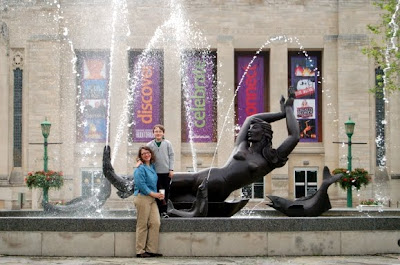
On Friday, we (meaning Dr. J, Merkin J. Pustart and I, Dudeboy) went to Bloomington because Dr. J. had a conference there. And in Bloomington we stayed at the Indiana Memorial Union Biddle Hotel. While Dr. J was at the conference, Merkin and I went to the IU Art Museum where we saw a Roman mosaic, an Egyptian mummy case, Greek vases, and other neat things in that exhibit. In a different exhibit, we saw things ranging from some very old cups made almost entirely out of ostrich eggs to modern art like cubes stacked on cubes. In a different art exhibit I saw African art including a gong made out of a tree trunk; it looked like a weird canoe to me. There was an exhibit of paintings of boats and landscapes like Mt. Vesuvius and ruins at night by Thomas Chambers. We then went to the Lilly Library which is a rare book and special collections library. They're having a new exhibit called "Of Cabbages and Kings: Unexpected Treasures of the Lilly Library." Here are some of the things we saw: an early edition of Through the Looking Glass, a first printing of "The Star-spangled Banner" sheet music, some of George Washington's hair, some math problems done by Abraham Lincoln, and a Gutenberg bible. They had a room called the Lincoln room with books about Lincoln and a writing desk he used while he was a lawyer. I got to touch a medieval manuscript of a book of hours. The vellum was so smooth on one side and had a bit more texture on the other. I got to hold the Oscar of John Ford for best director of How Green Was My Valley. I didn't actually feel the surface because I had to wear gloves or the gold coating would come off. The Slocum Puzzle Room has puzzles collected by Jerry Slocum. Mostly the puzzles were mechanical and some of them you could actually work. One of the puzzles that was behind glass was this one (I can only tell you it verbally): a farmer wanted to ferry a goat, a cabbage and a wolf across a river, and he could only ferry them across one by one. But if he leaves the goat with the wolf, the goat will get eaten, and if he leaves the goat with the cabbage, the cabbage will get eaten. So you have to figure out how to get them all across without any getting eaten. (Post your answers in the comment section and I'll tell you if you're right.) All of the Lilly Library seems too great for me to sum up. It has seven floors in all (but I only got to see the third floor by the main entrance) and that can hold a lot of rare books.

On Saturday I went to Wonderlab, a children's museum. There was a whole entire exhibit about dinosaurs and it had real dinosaur bones that you could really touch. They had other fossils including coprolites, giant shells bigger than your head, and a large ammonite. Downstairs they had a whole room about bubbles where you could see bubbles forming an uncontrolled sheet of several hundred bubbles. They also had a few bubble walls and a bubble speed comparer. There was also a fog table where you could make anything from a dam to a house and see how the fog moved around it. I made chimneys, and the fog poured out of the chimneys and looked like smoke. In a different part, I made a cannon with a mechanism where air would blow a ball through tubes. There was also an animations table and a light circuit table.
The last thing we went to in Bloomington was the Mathers Museum of World Cultures where I saw a reproduction of a kitchen and living room in Bloomington from the 1960s. Love currency? Then you'll love to see these throwing knives that were used as currency in the "Money Is An Object: African Currency" exhibit. We also saw decorative weapons that looked very scary. It's so much fun visiting other college campuses. I want to go back!

Dudeboy