Thursday, August 9, 2012

House Sitting Day 4 . . . Indiana

Pigeon Roost State Historic Site (War of 1812) near Underwood, Indiana.  Coordinated attacks by Native Americans near the beginning of the war at both Pigeon Roost and Fort Harrison put the Indiana settlers on constant alert.

At the village of Pigeon Roost, twenty-four settlers were massacred, including 15 children.  There is one horrific story of a mother unintentionally smothering her baby while trying to mute its cries while hiding from the attackers.

 Reconstruction of Fort Vallonia in Vallonia, In.      


The Medora Covered Bridge is the longest historic covered bridge in the U.S.  

It was originally built in 1875 and has recently been renovated.  

It has a total length of about 460' . . . for scale, Dudeboy is that small spot in the far-end opening.

Wednesday, August 8, 2012

House Sitting Day 3 . . . Historical Museums and Such

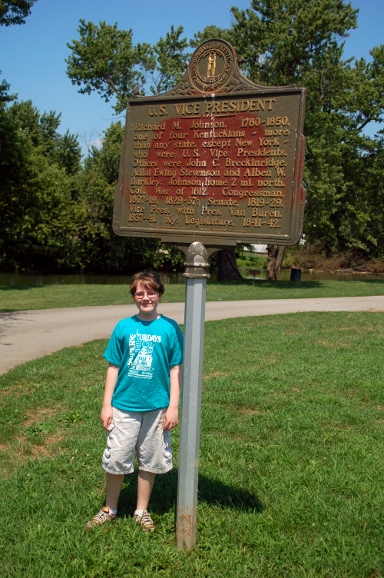
Today started off with a quest for Richard Mentor Johnson . . . the ninth vice-president of the United States.  Did you know that Kentucky has 4 vice-presidents?  Only New York (11), and Indiana (5) have more.  Massachusetts also has 4.

"Rumpsey Dumpsey, Rumpsey Dumpsey, Colonel Johnson killed Tecumseh."  Johnson is also credited as the man who killed the great Tecumseh at the Battle of the Thames (Battle of Moraviantown) during the War of 1812.  This display about Johnson is located at the Georgetown and Scott County Museum. Johnson lived in Scott County.  He is also infamously known for having a longterm relationship with his slave Julia Chinn, whom he basically treated as a common-law wife.

This desk and chair are from the trial pertaining to the assassination of Governor William Justus Goebel.  After a disputed election, Goebel was sworn in as governor one day after being shot.  He died a few days later.  On the trip we also saw the bullet that killed him, and the vest and coat he was wearing when he was shot.  Of course, Dudeboy, on previous trips, has visited the site where Goebel was felled and his gravesite.

An exhibit about Daniel Boone is at the Thomas D. Clark Center for Kentucky History in Frankfort.

A casting of the skull of Daniel Boone.

Switzer Covered Bridge in Franklin County.


Tuesday, August 7, 2012

House Sitting Day 2, Part 2 . . . Rafinesque and Moosnick

While in Lexington we were lucky enough to visit a couple of curious attractions at Transylvania University, which is the oldest university west of the Allegheny Mountains and 16th oldest university in the nation.  Thanks to the kind efforts of Dr. Day we were able to visit the tomb of Constantine Samuel Rafinesque . . . the noted nineteenth-century naturalist, linguist, anthropologist, etc.       

Rafinesque was a contemporary of Audubon who apparently named more new species and genera than any other scientist.  Yet, his story is odd in life and death.  For example, he probably is not buried in his tomb . . . the outside of which is shown in the photo above.  The structure to the side of the stairs and behind Dudeboy is the tomb.

Then Dr. Day led us to one of the hidden treasures of our state . . . The Monroe Moosnick Medical and Science Museum.  Apparently, this is one of the best, if not the best, collections for the time period of 1820 to 1850.  It is only open by appointment.      

According to the placard, this "Medical Venus" is one of only five known life size dissectible wax figures created by La Specola of Florence, Italy still in existence.  Dr. Day related a funny story about how he found her in the storage area.


Dr. Day said this is a hairball from a cow (or maybe it was from a buffalo).


House Sitting Day 2, Part 1 . . . Henry Clay and Mary Todd Lincoln

"House sitting" on day 2 partly consisted of touring a couple of other homes.  Our first sojourn took us to Henry Clay's estate Ashland.  As with most of these fancy pants historic homes photography within is prohibited.

Clay might not recognize the home today as his son rebuilt the home upon the original foundation.  Still, it is a beautiful home . . . Dudeboy and I were both particularly taken with the library.

 Henry Clay's law office from 1803 to 1810.  

The tomb of Henry Clay in the Lexington Cemetery.  

Mary Todd Lincoln's house . . . It is impossible get a decent picture of the front as the very busy thoroughfare of Main Street encroaches within feet of the home.  As with Ashland, no photography is allowed inside of the house.

Monday, August 6, 2012

House Sitting Day 1 . . . Blue Licks and Boone

This past week Dudeboy and I have been house sitting for Aunt T.  House sitting for us apparently means spending very little time at the house sitting, for we went on excursions every day (all day) while we were there.  Mainly we traveled around the bluegrass region (but we did make one trip to Southern Indiana).  Our first adventure led us to the last cabin Daniel Boone lived in while he was in Kentucky before he left for Missouri in 1799.

I am not sure what, if anything, is original to the cabin.  I haven't found much information pertaining to this cabin.  However, if any of it is original then it is a shame that the state hasn't done anything to preserve it and protect it.

The cabin is located on private property not far from the Blue Licks Battlefield.  A historical marker is nearby on US 68.

One of the last engagements of the Revolutionary War was the Battle of Blue Licks.  For the Americans it was pretty much a debacle.  Wikipedia states, "It was the worst defeat for the Kentuckians during the frontier war."

I won't go into it much, but to show how desperate it got for the Kentuckians . . .

  • Colonel-Commandant John Todd was killed
  • 1 of the 2 Lieutenant-Colonels was killed: Stephen Trigg (D. Boone survived, but he lost a son) 
  • 2 of the 4 Majors were killed or died of wounds
  • 6 of 10 Captains were killed or captured
  • 5 of 5 Lieutenants were killed
  • the Kentuckians suffered a total of 72 killed and 11 captured compared to the British/Native American force's totals of 7 killed and 10 wounded 


 Burial monument for the "Martyrs of the last battle of the Revolution . . ." 

 The monument for the battle located at the entrance of the park.

Tanner Station . . . a recreation of a trading fort that was located near Blue Licks as early as 1784.


 Johnson Creek Covered Bridge in Robertson County.

Johnson Creek Covered Bridge is one of only 13 remaining covered bridges in Kentucky.  A good many were destroyed during the Civil War.


Monday, July 30, 2012

On Top of Old Smoky . . .

Here are some of the photos Dudeboy took while he was at Camp Quest of the Smoky Mountains located at the Great Smoky Mountains Institute at Tremont.


 Rattlesnake along the trail.  Dudeboy also saw a bear.

The rest of the photos were taken after we picked him up from camp.  We went up to Clingmans Dome and then hiked out to Andrews Bald.
 Clingmans Dome


 Clingmans Dome

 Andrews Bald

 Andrews Bald

At the end of the week . . .