Friday, September 14, 2012

War of 1812 Road Trip, Day 6 - Part 2 . . . Remember the Raisin!

“Remember the River Raisin” became a national battle cry in the War of 1812 after settlers and Kentucky soldiers were massacred by Indians on the river’s banks in violation of  protection promised by the British.The stream here was the center of a sturdy French – American settlement which took form 1780 – 86.In the period of controversy after the War of Independence and until 1794 British – Canadian authorities sought to establish the River Raisin as the international boundary and thus to retain possession of Michigan and control of the Great Lakes. Indians called the stream “Numasepee,” or River of Sturgeon. French settlers changed the name to “Riviere aux Raisins” which means River of Grapes. Early records tell of great masses of wild grapes which festooned the trees along its banks.

 A 1937 monument erected by the Daughters of the American Revolution, and etc., etc. . . .
First American flag raised on Michigan soil in Frenchtown by Capt., Porter 1796.  Site of River Raisin block house occupied by American troops.  Burned by the British Capt., Elliott under order of Col. Proctor. Aug. 1812.
This monument is right across the street from the very impressive Custer statue.  Monroe was the boyhood home of Custer.   

This stone marks the headquarters of General Winchester, which was located at the home of Col. Francis Navarre.  That house no longer stands, but there is now in its place a beautiful Italian Villa.  A nearby historical marker states, "General Winchester made the Navarre house his headquarters before the disastrous Battle of the River Raisin in 1813 in which Winchester was taken prisoner." 

Here were buried unidentified remains of victims of the River Raisin Massacre of 1813. In 1872 surviving veterans of that war gathered in Monroe from Ohio and Kentucky. They headed a colorful civic pageant which halted solemnly at this spot while the old soldiers paid military honor to their fallen comrades. General George A. Custer, a member of the local welcoming committee, read the roll call of the veterans.In 1904-05 the ladies of the Monroe Civic improvement Society induced city officials to establish the old burial ground as a park. Appropriation was made by the State of Michigan for the monument which stands as a permanent tribute to Kentucky and her militiamen.
There are only two flags displayed in the park . . . the U.S. flag and the state flag of Kentucky.  That, plus the monument, speaks volumes about the sacrifices made by Kentucky troops at River Raisin. 

Michigan's Tribute to Kentucky . . . erected in 1904 by the state of Michigan, this substantial monument  is located in Memorial Place Park.  From the dedication speech given by notable Kentucky historian (and Civil War veteran) Col. Bennett H. Young . . . 
Long delayed, at last with lavish hand this mighty Commonwealth of Michigan recalls the courage, patriotism and the death of these gallant slain, and this beautiful monument declares that Michigan, for whom these fallen soldiers died, "Remembers the Raisin."
Kentucky herself has been recreant to the memory of her glorious dead, but her people to-day with grateful pride recognize this tribute by Michigan to her sons who perished here nearly ninety-one years ago, and as a loyal son of Kentucky I come to bring you greeting from Kentucky's 2,500,000, and to thank you in their name for this memorial to her heroic children.   
In case it is hard to read in the photo . . . "This Monument is dedicated to the Memory of the heroes who Lost their lives in our country's defense, in the Battle and Massacre of the River Raisin, January 22nd, and 23rd, 1813."


Monument marking the Old Hull Road . . . "The Old Hull Road" over which the American Troops were driven by the English & Indian allies Jan. 22, 1813." 

Located on Kentucky Avenue is this marker for the Capture of Gen. Winchester . . .
Under attack by the British and Indians before dawn on Jan. 22, 1813, in the second Battle of the River Raisin, the U.S. 17th Infantry soon broke and fled south across the frozen river. Gen. James Winchester, the American commander, tried several times to rally these troops but was swept up in the route. Here he and his staff surrendered to the Wyandot Indian Jack Brandy, who delivered them to the British Commander, Col. Henry Proctor.Surrender was no guarantee of safety, however. After giving up, a group of 40 men led by Ensign Isaac Baker found themselves at the mercy of Indians who killed half their number. Those who kept running were tomahawked by Indians on horseback if they fell behind.
Before Chief Roundhead transferred Winchester over to the British he was supposedly stripped and painted.  There is a British cartoon from the time period representing Winchester's capture and subsequent abuse all to the amusement of British General Henry Proctor. 
 
The Old Hull Road Monument and Gen. Winchester marker.  Kentuckians under Winchester's command were not particularly fond of him (by the way, he hailed from Tennessee), even before what transpired at Frenchtown.  Much of the animosity had to do with Winchester being a little more cultivated and uppity than the "Alligator Horses" of Kentucky.

Missing marker for the Death of Col. John Allen . . .
Col. Allen tried vainly to rally the retreating Americans at the second Battle of the River Raisin, Jan. 22, 1813. Exhausted and disabled by a thigh wound, he faced the pursuing Indians near here. The colonel desperately defended himself at swordpoint before being killed.Col. Allen was one of the most influential men in Kentucky. He organized and then led the elite first rifle regiment, Kentucky volunteer militia. Allen had unsuccessfully run for the governorship of Kentucky in 1808 and was a member of its Senate at the time of his death. Counties in several states were later named in his honor.
Another missing marker.  This one marked the site of the First Battle of Frenchtown, or River Raisin . . .
Over this ground, Jan. 18, 1813, 667 Kentuckians and nearly 100 local Frenchmen charged across the frozen river toward the British and Indian positions. The 63 British and Canadian soldiers and 200 Potawatomi Indians made a brief stand there, then retreated with their cannon into a wooded area a mile to the north where the fighting raged for several hours...Across this ground during the second battle, Jan. 22, the Indians closely pursued the retreating U.S. 17th Infantry and its reinforcements. They tried to reform on the south bank, but became disorganized among farm lot buildings and fence rows. Constantly out flanked by mounted Indians, they fled south along a narrow lane, being fired on from both sides.
You can just see in the background the River Raisin, and just beyond that is the visitor center for the River Raisin Battlefield.

Indian Attack (also situated along Kentucky Avenue) . . .
The Second Battle of the River Raisin Jan. 22, 1813, found nearly 400 American soldiers caught in retreat down this old road to Ohio. Those few who made it to this point, over a mile south of their camp, were ambushed by hidden Indians. The 40 American bodies found here bore witness to the ferocity of the attack.The retreat was a disaster for the American army at Frenchtown. Out of the 400 men who fled, only 33 escaped, about 147 were captured and as many as 220 were killed by the pursuing Indians.
The American Surrender . . .
Protected only by a picket fence, nearly 500 Kentucky militiamen fought off three British charges on their camp along the river and silenced the British cannon with their long rifles in the second Battle of the River Raisin, Jan. 22, 1813.They fought for three hours until they saw a white flag approaching from the British lines. They were sure it was a plea for truce. To their surprise it was a message from their captured General. Unaware of their strong position and the approach of Gen. Harrison's reinforcements, Gen. Winchester called for surrender.
The Murder of Captain Hart . . .
Captain Nathaniel G. T. Hart, brother-in-law of Henry Clay and inspector general of American Army of the Northwest under Harrison, was killed here during the massacre of the River Raisin January 22 - 23, 1813.Captain Hart, wounded in battle, was rescued by a doctor from a log cabin field hospital just before the Indians set fire to it. Under escort of a friendly Pottawattamie and on horseback, he was about to make his escape when shot down by a Wyandot savage.Captain Hart was one of many sons of well known Kentucky families who sacrificed their lives in desperate effort to extend American protection to the pioneer settlers of the River Raisin.
Hart County, Kentucky was named after him.

British Victory at Frenchtown . . .
From near this spot on Jan. 22, 1813, 525 British soldiers and Canadian militiamen from Fort Malden under Col. Henry Proctor and some 800 Indians under Chiefs Roundhead and Walk-In-The-Water launched a pre-dawn attack on the sleeping American camp a mile south on the River Raisin. The British firepower included six small sled-mounted artillery pieces.The British soldiers, mostly from the 41st Regiment of Foot and Royal Newfoundland Regiment, suffered heavy casualties in three vain attempts to storm the main camp, protected by a picket fence and the skill of the Kentucky riflemen. The Canadian militiamen and the Indians, however, routed the unprotected American eastern camp which led to the American Army's defeat at this Second Battle of the River Raisin.
A historical marker just on the northern outskirts of Monroe that relates a bit more information about the Old Hull Road . . .
General Hull's army hewed out of the wilderness the first Michigan road when it advanced from the River Raisin to Detroit at the beginning of the War of 1812.In Monroe the original crossing of the river by Hull's Army was at a ford near the present Winchester bridge.North of Monroe, Hull's road followed an old Indian trail which is now the course of M-56, long known as the Old Dixie, which courses the shore line of Lake Erie and which, northwest of Oldport runs into the Old River Road, thence into Jefferson Avenue, Detroit.Hull's army engineers were the first to bridge the Huron River in anticipation of the movement to Detroit of men and supplies from Monroe where a quartermaster depot had been established.
"Hewed out of the wilderness" for a Burger King.

Tuesday, September 11, 2012

War of 1812 Road Trip, Day 6 - Part 1 . . . Remember the Raisin!

Remember the Raisin!  That'll be the battle cry for the next couple of posts . . . because we saw so much pertaining to the battle, there will be two entries for River Raisin.  Located in Monroe, Michigan, the River Raisin Battlefield is one of the newest additions to the National Park system.

There were actually two separate engagements in the area . . . the Battle of Frenchtown on January 18,1813, and the Battle of River Raisin a few days later on January 22, 1813.  In an attempt to retake Detroit, Harrison ordered a force (mostly Kentuckians) under Winchester in advance, but Winchester took the initiative without orders and advanced on to Frenchtown.  Here the Kentuckians easily dispersed a smaller force of British and Indians in a brisk engagement.  However, things would be different on the 22nd.     

The display above shows a member of the Kentucky militia in the distance on the ground.  The figure in the middle represents the US 17th Infantry.  And the figure in the foreground represents the Kentucky Rifle Regiment.  Referring to the Kentucky contingent, the information plaque states . . . "These high-spirited troops fought well and inflicted heavy casualties on the British and Canadians, laying down their arms only after being ordered to."

Henry Proctor (apparently also spelled Procter) and the British returned on the 22nd with their Indian allies under Tecumseh.  This time, aided with sled mounted artillery, they surprised the U.S. forces.  Winchester had ignored all warnings of a large British force moving in from the north and failed to adequately place pickets.  

A completely successful surprise attack by the Native Americans coupled with the artillery "consisting of six small cannons, mostly 3-pounders, with some small howitzers" overwhelmed the regulars of the 17th U.S. Infantry.

The marker states:
Elements of the U.S. 17th Infantry were camped in an open field just north of here when the British and Indians launched their surprise counterattack at dawn, January 22, 1813. The Americans held their ground here for 20 minutes before the Canadian militiamen with the British and Indians flanked them, forcing a retreat. Reinforcements arrived from the Kentucky militia camp to the west, but the Americans forces soon found themselves fleeing across the frozen river toward the old road to Ohio. Nearly 400 Americans were eventually swept into this retreat. Later, the British moved their cannon to this site, hoping to surround the Kentucky militia camp, which was still fighting courageously.


The surprise attack came from beyond the tree in the distance in the field above.  This counter attack resulted in the rout of the U.S. 17th Infantry, and eventually the surrender of the Kentuckians.  


The marker states:
In this vicinity and parallel to the driveway, a line of scattered human remains were detected in 2000, which may mark the main skirmish line of the 17th U.S. Infantry. The bodies of those killed lay exposed to the elements for some time after the battle. Eventually, the scattered remains were gathered up and buried at several sites, including Memorial Place on South Monroe Street, where the Kentucky Monument is located. In the 1830's, bodies were removed to military cemeteries in Detroit and Frankfort, Kentucky. Nine counties in Kentucky are named after men who fought at the River Raisin, 8 of whom died here. They are Allen, Ballard, Graves, Edmonson, Hart, Hickman, McCracken, Meade, and Simpson.
Continually throughout the Northwestern Campaigns, it was the poor and inept decisions of the U.S. commanders that directly led to the staggering and unbelievable statistics Kentuckians endured.  Winchester was captured fairly early on in the battle, and was unaware of the situation on the rest of the field and surrendered his whole force.
    
Actually the Kentuckians had performed very admirably repulsing three Bristish assaults with “coolness and intrepidity.”  One website pertaining to River Raisin states, "The Kentuckians on the left flank suffered five killed and about forty wounded. British losses were a staggering one-third killed and wounded. One British observer later noted that if the Americans had left their fortifications and charged, Proctor’s right flank might have collapsed.”  In fact, when a white flag was presented the Kentuckians were amazed to find out that it was they who were to surrender . . . by orders of  Winchester!  More on this in the second entry for River Raisin . . .
   
The marker for the First District Court of the Territory of Michigan partly reads "Jereaume's home held wounded American prisoners of war during the Massacre at the River Raisin. In the bitter cold of January 23, 1813 Indian allies of the British scalped those who could not walk and burned the house."


A 1904 monument with the inscriptions . . .
Site of Battles of Jan. 18 - 22.  Gen. Winchester in command, and River Raisin Massacre Jan. 23, 1813.  800 Americans under Cols. Allen, Lewis and Wells fought desperately against 3000 British and Allies under Gen. Proctor.  Forced to surrender, Tho' promised British protection, the prisoners left unguarded were attacked and killed by the Indians.


The marker states . . .
The American Capt. John Woolfolk hid in one of the French homes just east of here during the massacre at the River Raisin, Jan. 23, 1813. Indians searching the settlement found him. They claimed him as their prisoner and forced him to this spot. Powerless, the local French watched as Woolfolk's offer of $1,000.00 for safe passage to the British in Detroit was spurned by the Indians. They shot him and left his body lying in the road.Although the French settlers could not help Woolfolk, they did manage to ransom several other American prisoners with money, horses or other valuables.
Site of an early Indian trading post . . . 

The marker states . . .
The Great Indian Chief Tecumseh headquartered near here for over a month after the unsuccessful British And Indian siege of Fort Meigs in Ohio, July 1813. The British strategy was to use the Indians at the River Raisin to slow down any American invasion of Canada from Ohio. The Indians had to take food and shelter from the settlement when they received no supplies from the British.Tecumseh and his men withdrew to Canada shortly before refugees from the River Raisin led Col. Richard M. Johnson's Kentucky Cavalry into Frenchtown Sept. 27, 1813. It would be five years before the settlement was rebuilt after the devastation of the War of 1812.
The marker states . . .
On this property in 1812 was the trading post of John Anderson, famed Scottish pioneer of the River Raisin.Anderson, Colonel of the Militia in 1812, was taken prisoner at Detroit, later escaped.Mrs. Anderson, alone at the time of the River Raisin massacre, successfully defied frenzied Indians who invaded the premises and lapped from the basement floor whiskey which she had emptied from the barrels. Mrs. Anderson sat defiantly upon the family money chest as the savages threatened her with upraised tomahawks. "Shame, so many Indians fight one squaw," Mrs. Anderson cried. Cowed by her words the Indians left and the home was not further molested.

Thursday, September 6, 2012

War of 1812 Road Trip, Day 5 . . . Put-in-Bay

View from Catawba to South Bass Island and the Perry's Victory and International Peace Memorial.

The Perry's Victory and International Peace Memorial.  Built between 1912 and 1915 (it was not officially dedicated until 1931), this 352 foot monument commemorates Commodore Oliver Hazard Perry's decisive victory of the Battle of Lake Erie on September 10, 1813.

Unfortunately, while we were there the elevator, full with passengers, got stuck.  So, we did not get to see the views from the top.  Blast it all!

So, what we did get to see is the world's largest Doric column.

Obviously a monument this size must commemorate a significant event.  Perry's victory in the waters here allowed the U.S. to gain control of Lake Erie, which eventually led to the recapture of Detroit.  All of which led to the withdrawal of British forces to Moraviantown in Canada, where "Remember the Raisin!" was the battle cry of the Kentuckians as they swept the field.  

While denied the chance of reaching the top, we were allowed inside the rotunda.

The remains of three British (Robert Finnis, John Garland, and James Garden) and three American officers (John Brooks, Henry Laub, and John Clark) killed during the battle have been re-interred in a crypt here in the rotunda.
This monument in the DeRivera Park in the village of Put-in-Bay marks the original burial place of the six officers.  

You can see the original memorial in the background.

Perry's Cave, located at the Perry's Cave Family Fun Center, is --for the most part-- something akin to what one would see at Gatlinburg and the like.  For instance, you can play at the War of 18 Holes of Golf.  However, the exception to all of this is the actual cave.

The story follows that Perry's men in desperate need for clean water were able to partake of the underground source located within the cave.

The first battle that took place on Ohio soil.  The marker states:
The first War of 1812 battle on Ohio soil was fought here when about 60 exhausted citizen soldiers were ambushed by about 130 Indians on September 29. Twenty men held the Indians at bay from a cabin while the main body escaped by boat to Cedar Point. Two days later the defenders were rescued. Forty Indians including several chiefs and 8 Americans were killed in the skirmish, neither a victory nor a defeat for either side.   
The monument above is inscribed, "In memory of Mason, Simonds, & Mingus.  Who fell near this place in battle with the Indians.  Sept. 29, 1812."  I have seen this battle referred to in various sources as Crystal Rock, but the marker is located on the southside of the Marblehead Peninsula in Lakeside Marblehead.  It is all a bit confusing, because there is a small village of Crystal Rock located south of this location and across the Sandusky Bay!  Also, the photos taken here may look a bit bit odd because they were taken after it had turned dark.  

Monday, September 3, 2012

War of 1812 Road Trip, Day 4 . . . Toledo Area

As mentioned in a previous entry, there is the unbelievable statistic that while Kentucky supplied less than 5% of of total American soldiers, 64% of all of those killed during the War of 1812 were from the state.  That is more than all of the rest of the states combined!  Well, the battles of Dudley's Defeat (also referred to as Dudley's Massacre) and River Raisin were the main contibutors to those numbers.

During the first siege of Fort Meigs, as reinforcements from Kentucky arrived in the area they were ordered to attack British batteries across from Fort Meigs.  Their objective was to spike the cannons, and then proceed to the fort.  However, after accomplishing this task, the new recruits refused to pay heed to the orders and continued with the attack. 

They were drawn into an ambush where the British and Indians counterattacked.  Of the 800 or so in the initial attack on the batteries, only about 200 made it to the safety of Fort Meigs, the rest being killed or captured.  The historical marker above (located at the First Presbyterian Church in Maumee, Ohio) states that, "A British gun battery stood on the site in the War of 1812."  

The British had constructed Fort Miamis in 1794.  So formidable was the garrison, that "Mad" Anthony Wayne did not even make an attempt on it after the Battle of Fallen Timbers.  By the time of the War of 1812, the fort had fallen into ruins.  Still, what was left of the garrison was used by the British and their Indian allies as a staging area.  And it was here that the Kentucky prisoners were removed to after Dudley's Defeat.  And what transpired next is why the incident is sometimes referred to as Dudley's Massacre.  As Kentuckian Lt. Joseph R. Underwood described it . . . 
On our way to the garrison, we were stripped of the principle part of our clothing and valuables.  As we neared the garrison at Ft. Miami, the Indians formed a line to the left of the road . . . Here we were obliged to run the gauntlet into the fort, the Indians whipping, shooting and tomahawking their prisoners as they passed.  I escaped with the exception of some severe strokes over the back with their ramrods.
   

Fearing reprisals, it was at this momment that Tecumseh famously rode in and put a stop to the massacre.  Underwood continued . . .
. . . Tecumseh was seen coming with all the rapidity his horse could carry him.  Drawing near to where two Indians were in the act of killing one of the prisoners, he sprang from his horse, caught one by the throat and the other by the breast and threw them to the ground; drawing his tomahawk and scalping knife, he ran between the Americans and Indians, brandishing them with the fury of a madman, and daring any of the hundreds who surrounded him to attempt to murder another prisoner.
Asking the British commander Maj. Gen. Henry Procter why he had not prevented the massacre, Procter responded that he could not control them.  Tecumseh's response was on par with the famous N.B. Forrest quote,"if you were any part of a man, I would slap your jaws and force you to resent it."  Tecumseh scolded Procter, "Begone!  You are unfit to command; go and put on petticoats."
 
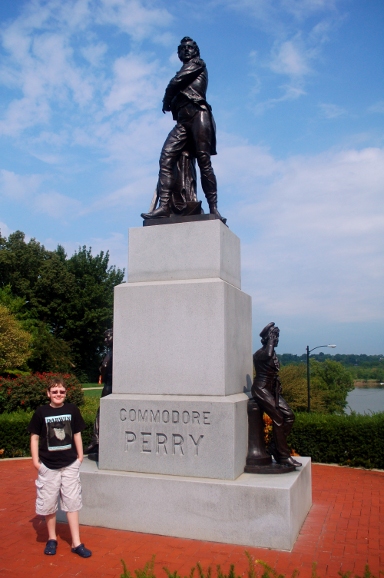
The Perrysburg, Ohio monument commemorating Commodore Oliver Hazard Perry . . . a copy of one created for the city of Cleveland in 1860.

We noticed a couple of cannons in Perrysburg, Ohio situated overlooking the Maumee River.  A plaque on one of the cannons explained . . .
Erected 1934. These cannon are from the frigate USS Consitution and were brought here by patriotic citizens of Perrysburg.  They are dedicated to the memory of Commodore Perry who drove the enemy off Lake Erie.
Fort Meigs, Perrysburg, Ohio.  Rebuilt on its original location, Ft. Meigs  is the largest wooden walled fortification in North America.  The monument at Ft. Meigs was erected in 1908 by the Grand Army of the Republic.  

The British and their Indian allies laid siege to the fort twice, the first resulting in Dudley's Defeat.  The second siege had Native Americans under Tecumseh feign a battle to lure the US soldiers out of the security of the fort.  It didn't work.

In addition to the extensive recreated fort, there is also a very exceptional museum devoted to Ft. Meigs and the War of 1812 in general.  Even if your interest level is somewhat less than ours, I daresay this would be a worthwhile stop if you happen to be in the Toledo area.

We were told that there is an effort to raise money for a Kentucky monument to be placed at Ft. Meigs.  Apparently, this was also proposed back in 1908 as well.  I don't know why the earlier monument was not constructed, but hopefully this latest attempt will rectify that slight.


A 5.5 inch howitzer . . .

Nearby, up a "sloping hill, on a little grassy plateau, is the Kentucky burial ground.  There are the sunken graves of forty or fifty of Dudley's slaughtered soldiers.  Their bodies were brought across the river by Harrison's men after Procter had left."  I'll have to seek this out when we return for the 200th anniversary.

Fort Stephenson . . . Fremont, Ohio.  After the two failed attempts to take Ft. Meigs, British commander Henry Procter switched his attention to the supply base of Fort Stephenson.  Not wanting to lay siege as he did at Ft. Meigs, Procter ordered a frontal assault by his infantry.

However, the commander of the fort, Kentuckian George Croghan, realized his men could withstand the attack.  Earlier, Harrison had ordered Croghan to withdraw to another supply base to which Croghan replied, "We have  determined to maintain this place, and, by heavens, we can."  With the assistance of the above 18th-century French 6-pounder naval cannon named "Old Betsy," Croghan's men not only weathered the attack, but actually repelled the British who sustained high casualties.
   
George Croghan was born at the Locust Grove Farm in Louisville in 1791.  In 1906 the people of Fremont had his body re-interred from his family cemetery at Locust Grove to this spot, the site of Fort Stephenson. 


After this engagement, Croghan became a national hero and was promoted to the rank of lieutenant colonel.  He was the youngest to hold that position.  Croghan died in a cholera epidemic in 1849.